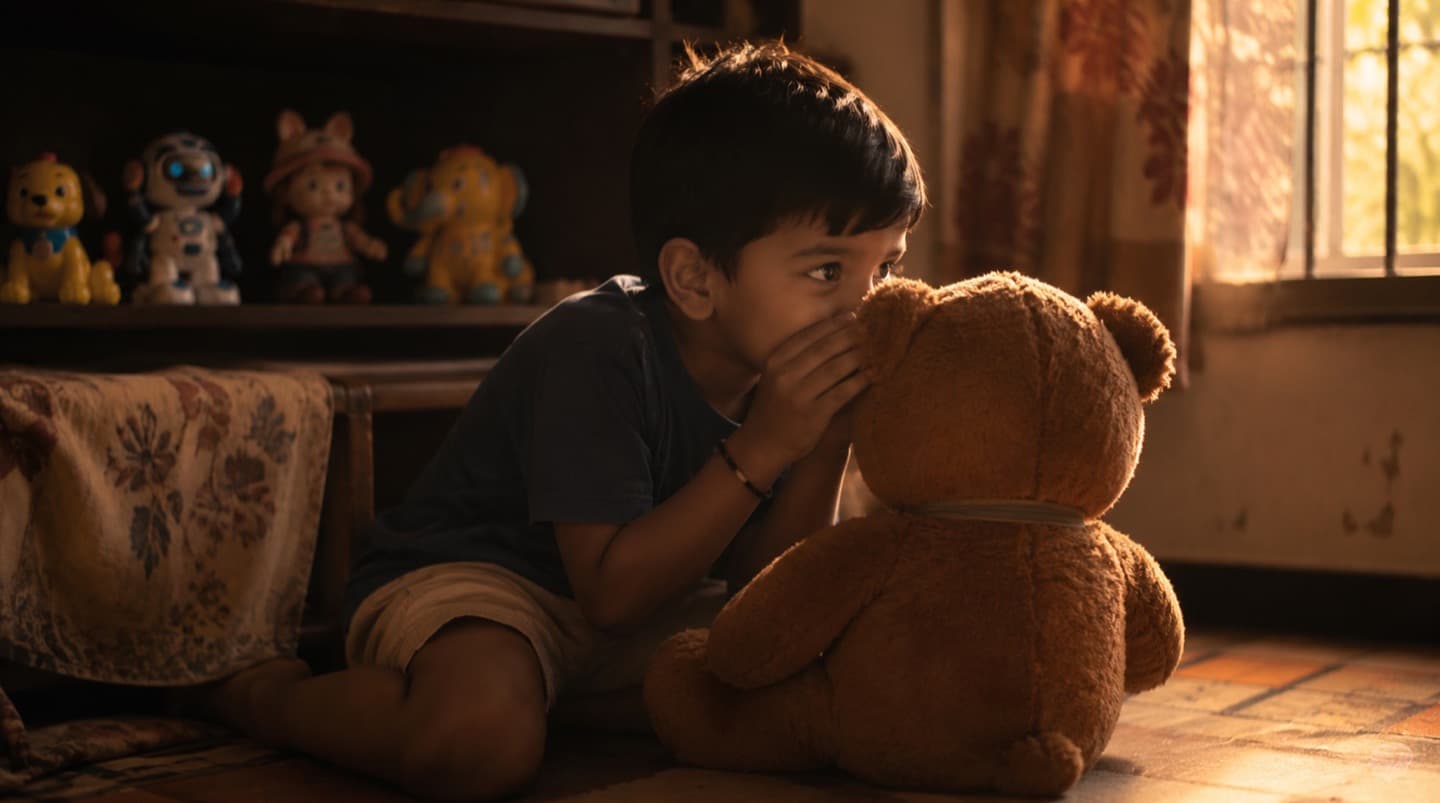
A toy that talks plays or repeats sounds at your child. A toy that listens understands what your child said and answers it, then asks something back. The difference matters because children learn language through back-and-forth turns, and a toy that cannot return the turn cannot start one, however much noise it makes.
Walk down any toy aisle in India and the talking toys line up: a dancing cactus that records what your child says and squeaks it back, phrase-button phones, dolls with six sentences, plushes that sing on a squeeze. Children find them hilarious, for about a week. They all talk. Almost none of them listen.
Why does repeating run out?
A toy that repeats gives your child their own words back. That is a mirror, and mirrors are entertaining, but they do not answer questions. Once the novelty fades there is nothing left to discover, which is why these toys migrate to the bottom of the basket by month two. A toy with six sentences runs out on day one. The child has simply heard them all.
What does listening actually do for a growing brain?
Researchers at Harvard describe how children learn to talk as serve and return: the child serves a sound, a look or a question, and someone returns it with meaning and a new serve. It is the return that builds vocabulary, logic and confidence. A 2018 study of 36 children aged four to six found that the number of conversational turns a child had with adults, not the number of words they overheard, tracked with activity in the brain's language region, whatever the family's income. A toy that only repeats never returns the serve. A toy that only performs never invites one.
Screens, speakers, talking toys, AI toys: how do they compare?
Here is the honest map, category by category, before we get to our own.
Apps and tablets
The richest content and the strongest pull. A cartoon can show your child a volcano, but it cannot pause when their eyes go wide and ask what happens next. The American Academy of Pediatrics asks for about an hour a day of good content for two to five year olds, watched together, because the learning happens in the talking about it, not in the watching. On its own, a screen is a performance.
Smart speakers
They listen and answer, which is a real step up, but they were built for adults. They reach the open internet, they answer anything, and they are not filtered for a three-year-old. Useful for music and timers. Not a friend for a child to talk to alone.
Talking toys that repeat or play phrases
Safe, simple, offline and cheap, and worth having for the giggle. They cannot answer a question they have never heard, so they cannot keep a conversation going, and the novelty runs out fast.
AI companion toys
The newest category, and the one with the loudest warnings. Common Sense Media's January 2026 assessment found that more than a quarter of the replies its testers logged were inappropriate, and advised against giving one to any child of five or under. Whether a particular AI toy belongs in this bucket or the next depends entirely on how it was built, and the five checks for a safe AI toy tell you which.
Kheelu
Kheelu is built to be the listening kind on purpose: it understands what your child says, answers from a closed library rather than the open internet, then asks the next question, in English, Hindi, Bengali, Telugu, Tamil, Kannada, Spanish, and French, with up to ten languages at launch, and every word readable in the parent app. Open conversation runs on your home WiFi; Story mode and Bluetooth music work offline.
A short checklist for any talking toy
If you are choosing a talking toy for a child under five, ask five things. Does it reply, or only repeat? Does it ask questions back? Does it speak your home language? Can you read afterwards what it said? And does it work without a screen in the room? Then put one more question to anything that calls itself interactive: can it answer something it has never heard before? A button toy cannot. A repeat toy cannot. Only a toy that understands speech and forms a reply can, and until recently that did not exist at toy prices.
If your house has a bored cactus in it, pre-orders are open, and a refundable ₹499 holds your place.
Sources
- Harvard University, Center on the Developing Child: Serve and return · developingchild.harvard.edu
- Romeo and colleagues: Beyond the 30-Million-Word Gap, children's conversational exposure and language-related brain function (Psychological Science, 2018) · pmc.ncbi.nlm.nih.gov
- American Academy of Pediatrics: Media and Young Minds, policy statement (Pediatrics, 2016) · publications.aap.org
- Common Sense Media, Youth AI Safety Institute: AI Toys risk assessment (January 2026) · institute.commonsensemedia.org

More reads like this on the journal, the mechanisms behind the promises on the Safety page, or meet the friend behind it on the Kheelu page.